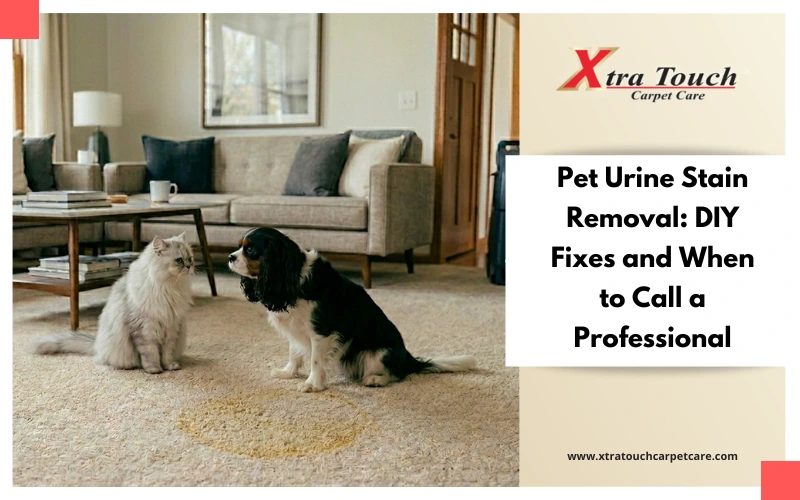
Whether it’s a dog or a cat, pets are family. But pet urine stain removal is one of the toughest cleaning challenges a homeowner will ever face, and one of the easiest to make worse with the wrong fix.
We’ve spent over 29 years treating pet urine stains and odors for Vancouver, WA homeowners. Here’s what actually works, what doesn’t, and how to tell when it’s time to call a professional.
How Do You Get Old Pet Urine Stains Out of Carpet?
Quick answer: Treat the area with a 1:1 vinegar-and-water solution, blot it dry, apply baking soda to absorb residual odor and moisture, then finish with a 3% hydrogen peroxide solution once the area is dry. This combination breaks down surface-level urine salts, but it won’t reach urine that has soaked into the carpet pad. That requires professional extraction.
Here’s the full at-home process for a stain that’s already set in:
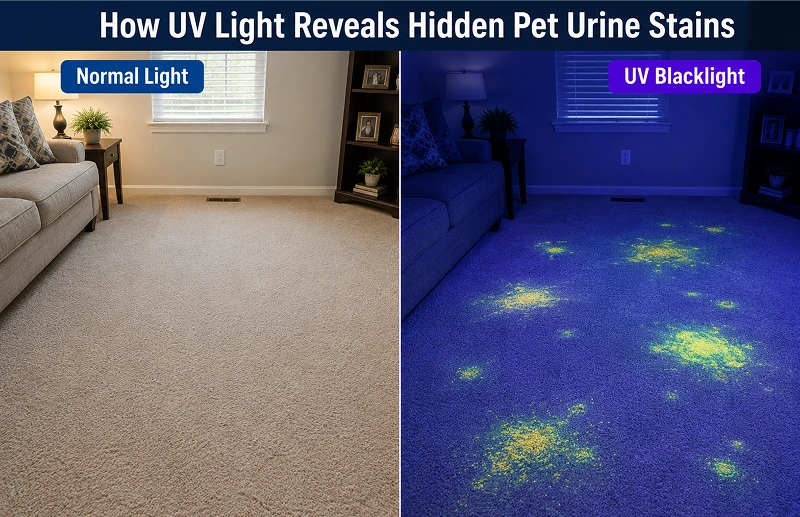
Find the stain. If you can’t see it but can smell it, use a UV blacklight in a dark room. Dried pet urine glows yellow or green under UV light, even when it’s invisible in normal lighting.
Treat with vinegar solution. Mix equal parts white vinegar and water and apply it generously to the stained area. Let it sit for 10 minutes; this helps neutralize the alkaline urine salts.
Apply baking soda. Spread a generous layer over the damp area and work it into the fibers with your hands. Baking soda absorbs both moisture and odor.
Let it dry completely. This can take up to 48 hours. Don’t rush this step: vacuuming wet baking soda just smears the residue back into the carpet.
Vacuum thoroughly once the area is fully dry.
Apply a 3% hydrogen peroxide solution for stubborn residue. Let it foam, then blot the area dry. Always spot-test hydrogen peroxide on a hidden area first, since it can lighten some carpet dyes.
If the stain or smell is still there after this process, the urine has likely reached the carpet pad or subfloor, and no surface treatment will fix that.
Why Is Pet Urine Stain Removal So Difficult?
1. Uric Acid Crystals Don’t Dissolve in Soap
Pet urine starts out acidic but crystallizes into alkaline salts as it dries. Bleach and dish soap can’t break down these crystals, and using bleach can actually strip the sheen and color right out of your carpet fibers. Household remedies offer temporary relief at best. Professionals use enzymatic and pH-balancing solutions specifically formulated to dissolve these crystals at the molecular level, not just mask them.
2. Hidden Stains Are Easy to Miss
Most pet accidents are unintentional, and most pet owners catch them quickly, but “quickly” still isn’t always quick enough to stop urine from wicking into the padding below. And accidents that happen while you’re out, or in low-traffic rooms, can dry completely before you ever find them. Professional technicians use UV inspection tools to locate every contaminated spot, including the ones you didn’t know were there, so nothing gets left behind to keep smelling or to keep attracting your pet back to the same spot.
3. Pet Stains Carry Bacteria and Odor-Causing Compounds
Pet urine contains bacteria that produce the sharp ammonia smell you associate with old stains. As that bacteria continues breaking down organic material, it spreads odor deeper into the carpet and into your indoor air. For households with kids, elderly family members, or anyone with respiratory sensitivities, this isn’t just unpleasant: it’s a real air quality and hygiene concern.
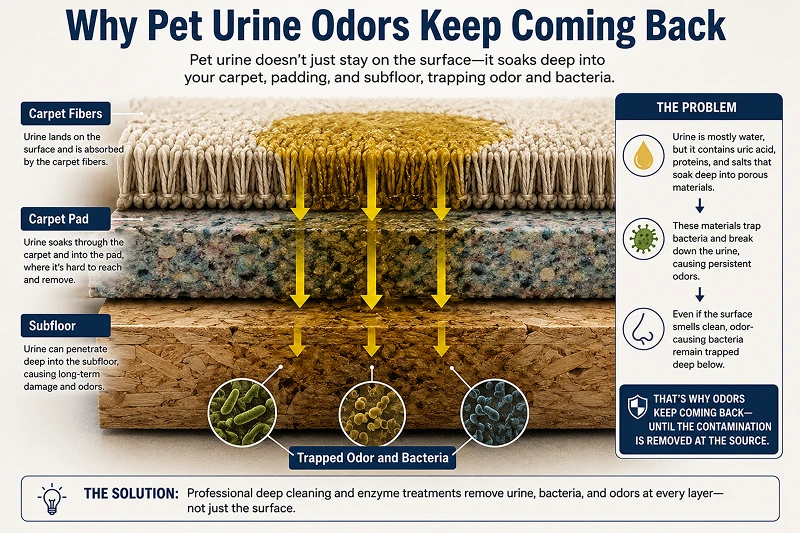
4. Urine Soaks Into the Pad, Not Just the Carpet
Carpet padding acts like a sponge. Once urine reaches it, the stain and odor source sits underneath your carpet, completely out of reach of any surface cleaner. Many homeowners treat the visible carpet fibers, feel satisfied, and then watch the smell return days later as residual urine wicks back up from the pad. Professional cleaners assess whether the pad needs flooding treatment, extraction, or, in severe cases, replacement.
5. Store-Bought Pet Stain Removers Often Just Mask the Smell
Many retail products marketed as the “best pet urine stain remover” reduce anxiety more than they remove urine. They’re rarely strong enough to fully break down set-in crystals, and several simply cover the odor temporarily rather than eliminating its source. Professional-grade enzymatic and oxidizing solutions aren’t sold to the general public. They’re formulated for sustained, deep-cleaning power that consumer products intentionally avoid for safety and liability reasons.
Mistakes That Make Pet Urine Stains Worse
Before you reach for whatever’s under the sink, avoid these common mistakes. Each one can turn a fixable stain into a permanent one:
Using steam or hot water on fresh urine. Heat permanently bonds urine proteins to carpet fibers, making the stain far harder (sometimes impossible) to remove later.
Scrubbing instead of blotting. Scrubbing pushes urine deeper into the pad and can damage the carpet texture, making the spot more visible once it dries.
Mixing cleaning products. Combining bleach-based and ammonia-based cleaners creates toxic fumes and can permanently discolor your carpet. Never combine cleaning chemicals without checking compatibility first.
Masking odor instead of removing it. Air fresheners and deodorizing sprays cover the smell temporarily, but pets can still detect the underlying scent and are likely to remark the same spot.
Treating only the surface. If a cleaning solution doesn’t reach the same depth as the contamination, the odor-causing residue stays behind and resurfaces, often within days.
When Should You Call a Professional Instead of DIY?
Quick answer: Call a professional if the odor returns after cleaning, if you can’t visually locate the source of a smell, if the stain is from an unknown or extended period, or if more than one or two accidents have happened in the same area. At that point, the contamination has likely reached the pad, and surface treatments won’t resolve it.
Specifically, it’s time to bring in a professional when:
You’ve already tried vinegar, baking soda, or a store-bought enzymatic cleaner and the smell is still there
The stain has been there for an unknown amount of time (set-in stains are far harder to fully remove)
You have multiple pets or a history of repeated accidents in the same area
You’re noticing odor without a visible stain, a sign that urine has spread under the surface
You have kids, elderly residents, or anyone with allergies or asthma in the home
A professional visit typically includes UV inspection to map every affected area, an enzymatic pre-treatment to break down uric acid crystals, hot water extraction to flush out bacteria and residue from deep in the fibers and pad, and a pH-balancing rinse to protect your carpet’s color and texture. In more severe cases, your technician may recommend flooding the pad with a neutralizing solution or replacing the affected padding entirely, something that simply isn’t possible with at-home tools.
Wondering what professional treatment may cost? See our guide on how much carpet cleaning costs and the factors that can influence pricing for pet urine and odor removal services.
Frequently Asked Questions
1. Does vinegar fully remove old pet urine stains?
⇒ Vinegar helps neutralize the ammonia smell and loosen surface residue, but it can’t break down uric acid crystals that have crystallized deep in the fibers or pad. For set-in stains, pair it with baking soda and hydrogen peroxide, or use a professional enzymatic treatment for full removal.
2. Is hydrogen peroxide safe to use on carpet?
⇒ In a 3% solution, hydrogen peroxide is generally safe for most carpets, but it can lighten certain dyes. Always test a hidden area first and wait to see the result before treating the visible stain.
3. How do you find a pet stain you can’t see but can smell?
⇒ Use a UV blacklight in a fully darkened room. Dried urine contains compounds that glow yellow or green under UV light, even on stains that are invisible under normal lighting.
4. Can professional cleaning guarantee full removal of pet urine odor?
⇒ In most cases, yes. Professional extraction and enzymatic treatment fully resolve odor and staining. However, if urine has saturated the carpet pad or subfloor over a long period, full remediation may require pad replacement rather than cleaning alone. A technician can assess this during an in-home inspection.
5. What’s the difference between professional and store-bought enzymatic cleaners?
⇒ Store-bought enzymatic cleaners are formulated for safety and shelf-stability, which limits their strength. Professional-grade solutions are higher concentration and are paired with truck-mounted hot water extraction, which reaches the pad, not just the visible carpet fibers.
Need Professional Pet Odor and Stain Removal in Vancouver, WA?
Pet accidents happen, and they don’t have to mean a permanently stained or smelly carpet. If you’ve tried home remedies and the odor or stain keeps coming back, the contamination has likely reached deeper layers of the carpet or padding. Continuing with stronger DIY methods can damage your carpet and still leave the source of the problem behind.
Contact Xtra Touch Carpet Care today for professional pet odor and stain removal. Our experienced technicians use advanced treatments and deep extraction methods to eliminate pet urine odors and stains at the source, helping restore a cleaner, fresher, and healthier home.
Xtra Touch Carpet Care
With over 29 years of experience, the Xtra Touch Carpet Care team shares expert advice on eco-friendly cleaning and stain removal. We help Vancouver homeowners maintain healthier homes with trusted tips, backed by decades of hands-on service and a commitment to local excellence.